|
The Origin of Species by Means of Natural Selection of the
Preservation of Favoured Races in the struggle for Life,
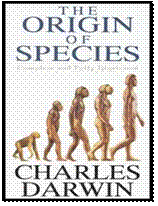
Darwin’s most inflammatory and renowned book, was
published on November 24, 1859. Darwin begins the book by
explaining that artificial selection, such as animal husbandry
and plant breeding, create variations in species which all
descend from a common ancestor. Darwin’s theory of natural
selection was a central theory in his overlying theory of
evolution. He described it as: “Owing to this struggle for life,
any variation, however slight and from whatever cause
proceeding, if it be in any degree profitable to an individual
of any species, in its infinitely complex relations to other
organic beings and to external nature will tend to the
preservation of the individual and will generally be inherited
by its offspring” (Origin of Species 96). Darwin
explained that all organisms are exposed to sever competition,
 compared
to a struggling country where some people adapt, some die, and
some emigrate. Darwin then reasoned that changes in species
also result from use and disuse of organs and environmental
stresses. Darwin explained that differentiation in flora and
fauna cannot be explained by environmental difference alone but
result from a combination of migration and decent with
modification. In regard of environmental stresses Darwin
elucidated that changes in climate and level of land can also
alter organisms’ adaptations. compared
to a struggling country where some people adapt, some die, and
some emigrate. Darwin then reasoned that changes in species
also result from use and disuse of organs and environmental
stresses. Darwin explained that differentiation in flora and
fauna cannot be explained by environmental difference alone but
result from a combination of migration and decent with
modification. In regard of environmental stresses Darwin
elucidated that changes in climate and level of land can also
alter organisms’ adaptations.
Although Origin of the Species was
revolutionary, Darwin diplomatically sought compromise in his
groundbreaking theory by providing potential difficulties and
shortcoming of this theory in his book. For example, Darwin
found that no intermediate forms existed between closely related
animals which would indicate evolution from a common ancestor.
Darwin also found that intermediate structure, adapted organs
formed from natural selection, may not be functional. Darwin
believed that different organs in organisms in the same class
were a potential disproof of his theory. Darwin also argued that
the longevity of mutated individuals was usually decreased.
Darwin’s theory of natural selection and evolution
can be summarized into three critical ideas. The basis of all of
Darwin’s work is the occurrence of evolution, which he defined
as a change in the
gene
pool of a population from generation to generation by such
processes as mutation, natural selection, and genetic drift.
Darwin’s second point stated that natural selection is the main
mechanism behind evolution. Darwin’s third main theory is
phylogeny, the concept that all life is related and originated
genealogically. Darwin’s theory of phylogeny was particularly
inflammatory because it attested that humans descended from
apes. Although Darwin saw the vast gap between primate and human
intelligence he found that apes shared human qualities, such as
moral reasoning, sympathy, beauty, and music, commonly believed
to be unique to humans. Phylogeny also sparked an expansive area
of debate in Darwin’s theory concerning human race. Darwin, a
stark abolitionist after witnessing slavery in Brazil while
touring the world on the Beagle voyage, believed that all
human races were sub-species of the same overlying human
species. He referred to difference in race as superficial,
caused by only minor alterations in skin color and hair type. He
described the similarities and intrinsic similarities between
races: “yet I was incessantly struck, whilst living with the
Fuegians on board the Beagle, with the many little traits
of character, showing how similar their minds were to ours; and
so it was with a full-blooded negro with whom I happened once to
be intimate” (The Descent of Man 231-232).
|


