|
 Strife, conflict, and debate between science and religion began as early
as Galileo’s Dialogue published in 1633 continuing to
modern day creationists. But during Darwin’s era, natural
science was rapidly evolving into a professional and modernized
practice. Common religious misconceptions could now be proven or
disproven using reasoning, experimentation, and research. One
such misconception was creationism. Creationism is the religious
belief that the universe was created by an omnipotent being. Strife, conflict, and debate between science and religion began as early
as Galileo’s Dialogue published in 1633 continuing to
modern day creationists. But during Darwin’s era, natural
science was rapidly evolving into a professional and modernized
practice. Common religious misconceptions could now be proven or
disproven using reasoning, experimentation, and research. One
such misconception was creationism. Creationism is the religious
belief that the universe was created by an omnipotent being.
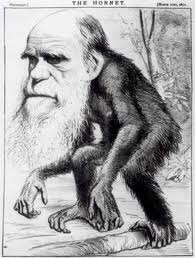
A political cartoon mocking Darwin's theory that
humans evolved from apes (Prigg).
The Anglican Church taught that God created the world exactly as recorded
in the book of Genesis in the Bible, which recorded the creation
of the universe and all living creatures occurring within seven
days. Darwin uprooted the common religious and cultural
evolutionary doctrine of creationism with his publication of
Origins of the Species. During his education and voyage on
the HMS Beagle Darwin supported the literal interpretation of
the Bible and God’s direct intervention in creation because of
his religion oriented childhood and religious education. In his
autobiography Darwin remarked:
“I was quite
orthodox,
and I remember being heartily laughed at by several of the
officers (though themselves orthodox) for quoting the
Bible
as an unanswerable authority on some point of
morality.
I suppose it was the novelty of the argument that amused them.
But I had gradually come, by this time, to see that the
Old Testament;
from its manifestly false history of the world, with the
Tower of Babel,
the
rainbow as a sign,
etc., etc., and from its attributing to God the feelings of a
revengeful tyrant” (Autobiography 85 ).
Gradually, however, Darwin strayed from the
creationism and developed his theory of evolution, which stated
that all life is related and has descended from a common
ancestor. Originally Darwin’s theory incorporated a divine being
where God initiated creation and His divine intervention crafted
species over time. Darwin claimed that some adaptations, such as
the human eye, were too complex to be formed by natural
selection alone but required a divine design. Besides generally
supporting the Church’s creationist position, the lay community
in Darwin’s time clung to several traditions which conflicted
with Darwin’s evolutionary theories, namely fixity of species.
Fixity of species generated the public skepticism of Darwin’s
work. Fixity of species originates from creationism and argues
that all species remained unchanged throughout the history of
the earth. Fixity of species stated that every organism was
created by God in its present, ideal form. Darwin contradicted
this common belief through his theory of phylogeny. Today the
Catholic Church and most religions have abandoned the
creationism and now accept evolution as scientific fact,
advocating theistic evolution, which is evolution caused and
guided by God.
Darwin’s personal religious life migrated from apathetic to
zealous to agnostic, a journey which influenced and infiltrated
his writings; this religious journey also sparked public
controversy and interest during Darwin’s life. Darwin attended
an Anglican public school during much of his childhood, an
environment he resented compared to his naturalist hobby. While
studying to become a clergyman Darwin studied Christian dogma
and theology. He was particularly impressed by John Bird
Sumner’s Evidences of Christianity, which logically
advocated the legitimacy of Christianity. His wife Emma
constantly challenged and questioned Darwin about his theory and
religion. They often discussed the connection between
Christianity and their shared Unitarianism roots. Darwin’s doubt
in God was initiated by the death of his daughter Annie in April
1851. Although his faith had been dwindling, after Annie’s death
Darwin stopped attending church services and denounced any
afterlife. Annie’s death proved the main impetus for Darwin’s
conversion into Theism. His work actually strengthened his
belief in the existence of a divine being. “The extreme
difficulty or rather impossibility of conceiving this immense
and wonderful universe, including man with his capacity of
looking far backwards and far into futurity, as the result of
blind chance or necessity. When thus reflecting I feel compelled
to look to a First Cause having an intelligent mind in some
degree analogous to that of man; and I deserve to be called a
Theist” (autobiography). Darwin is commonly portrayed in
conflict and debate with the Anglican Church but he and Emma
supported local parishes, namely Downe parish in Kent.
Darwin’s personal religious life mirrors his journey through
compromise with the Anglican Church’s standpoint on evolution.
Born into an Anglican and Unitarian family, Darwin was
surrounded by both, conventional Anglican doctrines, including
creationism, and the free-thinking practices of Unitarians.
Darwin’s education at Cambridge College and early interest in
geology and natural sciences was heavily influenced by the
religion of his day. He studied Paley’s Natural Theology,
which argued God had a direct hand in adaptations, and Lyell’s
uniformitarianism or “progressive creationism” geological
theory. Both Paley and Lyell influenced Darwin’s early
evolutionary theory, a combination of creationism and
uniformitarianism. Darwin’s personal religious beliefs
influenced both his political standpoints and his work. Darwin
was a liberal Whig and supported the Great Reform Act of 1832,
which franchised (gave voting rights) to millions of middle and
lower class English citizens. Darwin’s opposition to slavery
originating from his study of phylogeny and led him to support
abolitionists. In a letter written to his sister Catherine in
1833 Darwin remarked: “What a proud thing for England, if she is
the first European nation which utterly abolishes it [slavery]”
(Letter 206). Darwin’s research and theory led to
several worldwide political and social debates, such as applying
natural selection to humans. If Darwin’s theory of natural
selection was to be applied directly to humans the most adapted
humans-the rich and affluent-would hold all the power over the
population and would eventually eradicate the weaker population.
Darwin remarked about the public’s incorrect application of his
theory in a letter written to colleague Charles Lyell: ”I have
received in a Manchester Newspaper a rather good squib, showing
that I have proved “might is right” and therefore that Napoleon
is right and every cheating tradesman is also right” (Letter
2782).
|


