|
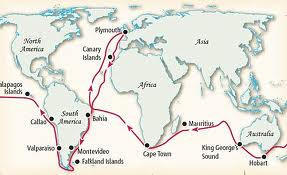
A map of Darwin voyage on the
HMS Beagle
|
|
|
|
|
Charles Robert Darwin was born on February 12, 1809 in
Shrewsbury,
Shropshire,
England to Robert and Susannah Darwin. During his
childhood Darwin developed a passion for botany and
natural sciences along with an inclination for
collecting small creatures and backyard treasures. He
attended Dr. Butler’s School in 1818, beginning his
formal religious and scientific education. Darwin
originally attended the University of Edinburgh to
pursue a career in medicine but changed career paths and
attended the University of
Cambridge to become a
clergyman. Here the geologist Adam Sedgwick and
naturalist John Stevens Henslow rekindled Darwin’s
passion for science and nature. Henslow persuaded Darwin
to embark on the HMS Beagle, a South American
voyage which would alter both Darwin’s life and the
course of scientific history through his observations of
patterns and alterations
in the native wildlife. Some of Darwin’s most
enlightening observations took place on the Galapagos
Islands, a cluster of small islands which offered
inspiration for Darwin’s theory of evolution. Returning
to England in 1836, Darwin began recording his
observations and theories, eventually compiled into his
renowned On the Origins of Species which was
published in 1859. In 1839 Darwin married his cousin
Emma Wedgewood, an Anglican who shared his Unitarian
background. Together they raised 10 children, 3 of whom
passed away during infancy. Darwin continued to expanded
his theory of evolution in his works
The Variation of Animals
and Plants Under Domestication in 1868,
The Descent of Man in 1871, and
The Expression of Emotion in Man and Animals in 1872. Much
of Darwin’s later years were spent battling illness,
public criticism, and personal religious turmoil caused
by the sudden death of his daughter Annie.
Darwin died
on April 19th, 1882 from a heart attack. He
is buried in Westminster Abbey. |
|
|
|


